When Paperwork Becomes a Business Cost
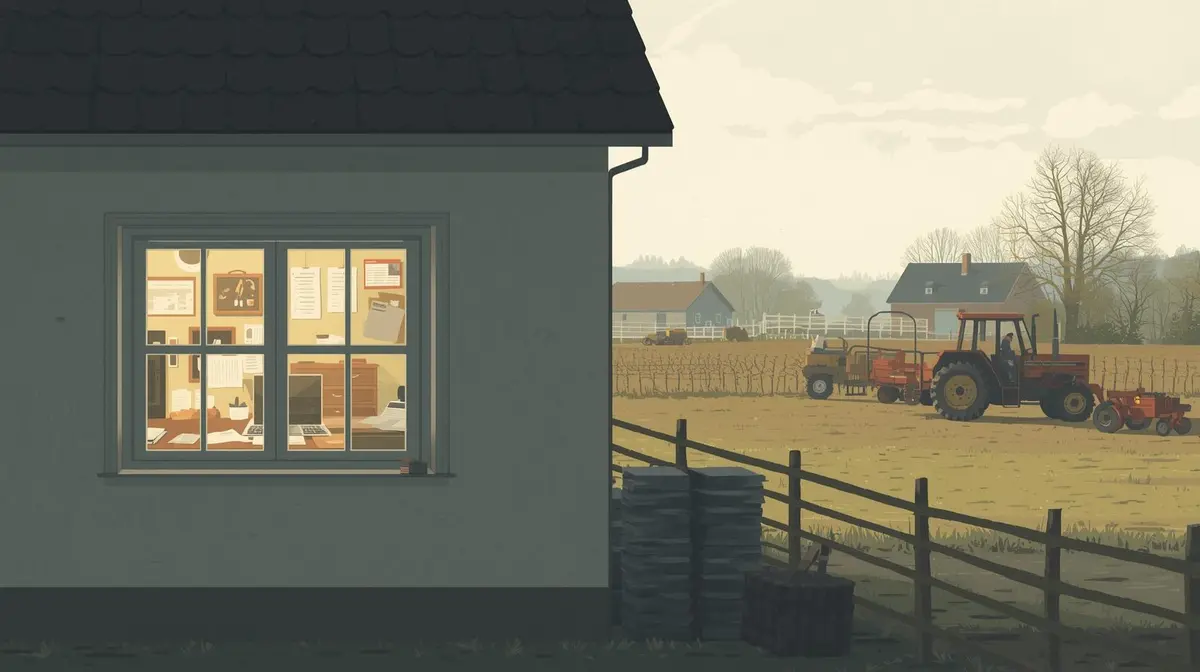
March. The field season hasn’t started yet, but the workday ends at 21:00.
Not because of livestock, repairs, or spring preparation. Because of files that need uploading, declarations that need cross-checking, and a certificate renewal that requires three separate forms from two different portals.
The work on the farm is manageable. The workaround isn’t.
The slow accumulation
Administration doesn’t arrive as one large project. It arrives as “just one more thing.”
A scheme that requires quarterly reports. A certification that needs annual documentation. A grant with interim deadlines. Each one is reasonable on its own. Together, they create a second job that runs parallel to farming.
Most farms don’t see this as a cost because nothing gets invoiced. The time goes somewhere between evening and night. The mental load sits in the background as a reminder system: what’s due next week, what needs checking, what might trigger a control.
The real cost shows up differently.
In delayed decisions about next season because focus is fragmented. In missed market opportunities because the timing didn’t align with a submission deadline. In conversations that get postponed because there’s always something administrative that can’t wait.
The paperwork itself might be unavoidable. The volume often isn’t.
When time stops being abstract
Five hours per week sounds manageable.
It’s not five hours of focused work with a clear result. It’s 30 minutes here, an hour there, interruptions that break the flow of other decisions. Documentation that requires gathering information from three different places. Forms that reference each other in ways that demand re-reading the instructions every time.
For a farm participating in two support schemes and one certification program, this is the baseline. Add a project application or a control preparation, and it doubles.
The financial cost isn’t direct. Cash flow from operations doesn’t change because of paperwork. But cash flow decisions get worse. A purchase that should happen in April gets delayed until June because the subsidy payment timeline is unclear and the farmer doesn’t want to commit without certainty.
That delay costs money. Not as a penalty, but as a missed price window or a season that starts under pressure.
Energy cost is harder to quantify, but it shows up everywhere. The farm operator who used to think clearly about production strategy now thinks in submission cycles. Decisions get deferred not because they’re difficult, but because mental capacity is already allocated to tracking deadlines.
The breaking point isn’t dramatic. It’s gradual. One year, the farm still runs normally with administration in the background. Two years later, the administration runs normally with farming in the background.
What actually reduces the load
The instinct is to get better at paperwork. Faster filing, better systems, digital tools.
That helps at the margins. It doesn’t reduce the core issue, which is volume.
Reducing volume means evaluating each administrative obligation separately:
- Does this scheme provide income that wouldn’t exist otherwise, or does it provide income that replaces market income at a higher administrative cost?
- Does this certification open access to buyers who demand it, or does it exist because the system rewards its existence?
- Does this project strengthen the farm’s structure, or does it add activity that justifies its own administration?
Some schemes are unavoidable. They’re tied to baseline support or market access that’s non-negotiable. Those stay.
Others are optional but positioned as standard. Participation feels necessary because other farms do it, or because the support exists, and leaving it unused feels wasteful.
The distinction matters.
A 40-hectare mixed farm operating in three agri-environmental schemes and one quality certification spends roughly 8–10 hours per week on related administration. If one scheme delivers €3,000 annually but requires 120 hours of specific documentation, that’s €25 per hour before considering the indirect cost of fragmented attention.
If the same farm could replace that income through a direct supply agreement that requires 20 hours of annual coordination, the trade-off becomes visible.
Not every scheme has a replacement. But not every scheme justifies its administrative weight either.
What doesn’t work
Adding more support to compensate for the cost of existing support doesn’t solve the problem. It compounds it.
A second certification might open another market channel. It also adds another reporting cycle, another control risk, and another set of requirements that need tracking. The new income comes with new overhead that wasn’t part of the initial calculation.
Digitalization is often presented as the solution. Moving from paper to portals, from physical submission to online filing.
That improves speed. It doesn’t reduce the number of requirements. A digital form with 40 fields is still 40 fields. The system is faster, but the farmer’s time investment stays roughly the same.
Outsourcing administration to a consultant or advisor helps farms that can afford it. It moves the time cost into a financial cost. That’s a valid trade-off for some operations. For others, it just converts one constraint into another.
The real inefficiency isn’t the tool. It’s the obligation structure. If a scheme requires documentation that serves the scheme’s accountability rather than the farm’s operational clarity, the administration exists for the system, not for the farmer.
Reducing that requires cutting participation, not optimizing compliance.
The decision that’s already happening
Most farms don’t formally decide to let administration take over. It happens by default.
One scheme leads to eligibility for another. That one opens access to a third. Each step is logical. The cumulative load isn’t.
At some point, the farm operates less as a production unit and more as a compliance unit that happens to produce something.
That shift is visible in how time is spent, but also in how decisions are framed. Instead of “What does this farm need to stay viable?”, the question becomes “What does this farm need to stay eligible?”
The difference is structural.
Farms that remain production-focused use support where it strengthens operations. Schemes exist to buffer income volatility or fund specific improvements that make sense independently of the support itself.
Farms that become compliance-focused organize production around support availability. Cropping decisions follow scheme requirements. Investment timing follows grant cycles. Marketing happens after administration, not alongside it.
Both can be financially stable in the short term. Only one is operationally sustainable long-term.
Can a farm stay in the system and remain production-focused? Yes, but only if the scheme portfolio stays within the threshold where administration supports farming rather than replacing it. For most small to mid-scale farms, that threshold sits somewhere between two and three active schemes, depending on complexity. Beyond that, the administrative load doesn’t just increase. It changes the nature of the operation.