Five Technologies That Will Change Farm Work
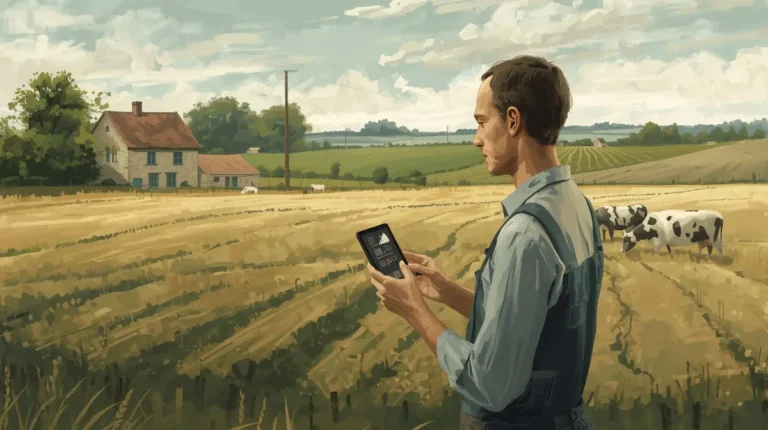
Most farm technology provides better information, but still requires the farmer to interpret it and act. A system that tells the farmer when to irrigate has relocated the decision from the field to a screen. It has not reduced the workload. What matters is whether technology removes something from the farmer’s plate or just reorganizes it.
This article evaluates farm technology through that filter: does it reduce the number of decisions a farmer makes each day, or does it add another thing to monitor?
The Value of New Technologies brings
Three questions separate technology that reduces pressure from technology that reorganizes it:
Does it remove a daily decision? A system must eliminate a decision entirely, not improve it or speed it up. A system that tells the farmer when to irrigate still requires interpretation and action. A system that irrigates automatically based on soil moisture removes the decision.
Does it reduce supervision load? Technology that replaces one manual task with three monitoring points has not reduced cognitive load. The farmer remains responsible for the outcome but now watches sensors, software, and connectivity instead of watching crops or animals directly.
What breaks when it fails? Systems that fail in ways the farmer cannot diagnose or fix create new dependencies. A mechanical breakdown can be assessed and often field-repaired. A software error or sensor malfunction usually cannot. Technology that shifts risk from farmer control to external support changes the operational profile of the farm.
These three criteria eliminate most of what gets demonstrated at agricultural fairs. They leave two categories: technology that genuinely shifts responsibility away from the farmer, and technology that becomes mandatory regardless of whether it reduces operational burden.
Technologies That Already Remove Decisions
Automated milking systems. The primary value is schedule elimination. The farmer no longer decides when to milk. The cow decides, and the system executes. The farmer still monitors refusals, checks udder health, and manages traffic patterns, but the twice-daily fixed schedule is gone. That represents a genuine reduction in decision load, not just efficiency. The trade-off is cost and dependency: capital expense is high, service response time becomes critical, and when the system fails, the farmer usually cannot fix it without specialized support. This works for farms where labor scheduling is the binding constraint. It does not work where margins are tight, service is slow, or herd size is under 60 cows.
Weather-triggered irrigation. Soil sensors, forecast data, and automated valves form a closed loop. The farmer sets thresholds once, usually with advisor input, and the system handles daily execution. Monitoring is still required: checking that valves opened, that sensors are accurate, and that rainfall was recorded correctly. But the daily irrigation decision has moved from the farmer to the system. The trade-off is technical dependency and calibration drift. If sensors fail or connectivity drops, the system either does not irrigate or over-irrigates, and diagnosis requires knowledge most farmers do not have. This makes sense on high-value crops where timing affects quality and margins support subscription costs. It does not make sense on field crops where rainfall is variable and manual irrigation was already infrequent.
Feed mixing automation with ration software. This removes a repetitive calculation and physical task. The system follows a programmed ration, adjusts for ingredient availability, and logs delivery. The farmer monitors intake and body condition but does not mix, weigh, or calculate daily. The trade-off is calibration dependency: if load cells drift, the error accumulates over weeks before it shows up in animal performance. This works on dairy or intensive feeding operations where ration consistency matters and ingredient costs justify precision. It does not work where rations change frequently based on available forage or where feed is managed through opportunistic buying.
These three share a pattern: they eliminate a repetitive decision or task and replace it with periodic supervision. They do not remove all management, but they reduce the frequency and change the type of attention required.
Technologies Becoming Unavoidable
Digital field records and traceability systems. These do not reduce workload. They increase it. Farmers who kept minimal records or paper logs now maintain digital documentation of every input, application date, and harvest batch. This technology spreads not because it helps farm operations but because buyers, certification bodies, and CAP subsidy programs increasingly require it. By 2027, most EU farms selling into certified supply chains or receiving area-based payments will need digital traceability, not because it improves decisions but because it is a market access condition. The cost is subscription fees and data entry time. The alternative cost is exclusion from premium markets or delayed subsidy payments.
GPS guidance on tractors. Guidance systems do not change what the tractor does. They reduce operator fatigue and improve pass accuracy. They become standard not because every farm needs them but because used equipment increasingly comes with guidance installed, and younger operators expect it. The trade-off is annual software subscriptions, GPS signal dependency, and calibration requirements. On small or irregular fields, the benefit is marginal. On large open fields or during long days, the reduction in operator fatigue is measurable. This spreads not because it is economically essential but because it is becoming default equipment, like power steering decades ago.
These technologies follow a different logic: they are adopted because the cost of not adopting them is exclusion, delay, or competitive disadvantage. They do not reduce operational pressure. They shift the compliance burden from paper to software without reducing the underlying requirement.
Technologies That Add More Than They Remove
Autonomous tractors and field robots. These attract significant attention and pilot funding, but remain rare on working EU farms in 2026. The limitation is operational, not technical. Autonomous systems work best on large rectangular fields with minimal obstacles and consistent conditions. Most EU small-to-medium farms have irregular boundaries, mixed terrain, nearby roads, and frequent interruptions. The systems require high-quality mapping, stable connectivity, and remote monitoring in case of software errors or unexpected obstacles. They relocate supervision from the cab to a screen. They do not eliminate it. The cost is extremely high, manufacturer dependency is total, and flexibility is limited when conditions change quickly. For most farms under 200 hectares, this solves a problem they do not have. It works for contractors on flat open land. It does not work where farming involves constant adjustments based on what the operator sees.
Drone-based crop monitoring. Drones generate detailed vegetation indices and stress maps. The images are precise. The decision value is limited. A farmer walking the field sees the same stress patterns several days earlier and acts immediately. The drone provides documentation, but the data still requires interpretation, and the action still requires the farmer to go to the field. The cost includes equipment, flight restrictions, and training to interpret spectral data. On very large fields or crops where early disease detection significantly changes treatment costs, drones add value. On mixed farms with small fields and frequent scouting routines, they add visual appeal but not operational benefit. Most farms adopting drones do so because advisors recommend them or because they are visually impressive, not because they reduce decisions or workload.
AI-driven decision platforms. These systems analyze weather, soil data, prices, and historical yields to generate recommendations: when to plant, spray, or sell. The recommendations are often correct. The problem is that experienced farmers already know most of what the system suggests, and when the system recommends something unexpected, the farmer verifies independently before acting. The cost is subscription fees, data sharing requirements, and recommendations that assume average conditions rather than farm-specific factors the algorithm cannot measure: equipment availability, neighbor activity, personal risk tolerance, and labor schedules. These platforms work for inexperienced farmers or remote managers. They add limited value for operators who already know their land and make decisions based on factors the system does not see.
These technologies share a characteristic: they provide information, perform tasks differently, or generate visibility, but they do not reduce the number of things the farmer must pay attention to. They relocate work without reducing cognitive load.
Which Pressure To Address First
Technology that reduces pressure does so by removing decisions, not by adding information. A system that provides better data still requires the farmer to interpret it and act. A system that automates a task but requires daily monitoring has not reduced workload. It has relocated it.
Most EU farms working 50-200 hectares with family labor and occasional hired help do not need autonomous machinery, drone monitoring, or AI platforms through 2028. What they need is clarity about which category of pressure limits the farm: daily workload, supervision load, or compliance risk.
If the daily workload is the constraint, the same tasks repeat every day, and no additional labor is available. Then, automated milking, weather-triggered irrigation, or feed automation are worth evaluating. They do not reduce total hours dramatically, but they remove fixed schedules and repetitive calculations.
If supervision load is the constraint, the farmer is constantly monitoring, adjusting, and deciding. Then adding more dashboards makes things worse. The test here is unforgiving: does the system make decisions independently, or does it give the farmer more information to process? Most farm technology does the second while advertising the first.
If compliance and market access are the constraints, subsidy processing is slow, certification audits are frequent, and traceability requirements are increasing. Then digital records and automated reporting are not optional anymore. The cost is time and subscription fees. The alternative is delayed payments or market exclusion.
The farms that benefit from technology are usually not the ones adopting early. Early adopters absorb the learning curve, discover weak points, and pay premium prices. Late adopters benefit from dropped costs, known failure modes, and established service networks.
Technology adoption makes sense when it removes something specific that currently limits the farm. It does not make sense when it is adopted because it sounds advanced, because neighbors have it, or because vendors claim it will improve efficiency. Efficiency is not the issue for most farms. Decision load is.
Test one system. Evaluate it for six to twelve months. Keep manual backups running in parallel. Ignore everything that requires learning a new technical skill unless that skill directly replaces something harder. Technology adopted carefully reduces pressure. Technology adopted quickly usually increases it.