What Is Smart Farming? The €5K-50K Decision Every Farm Faces
Smart farming means connecting sensors, software, and machinery so farm decisions respond to measured conditions instead of schedules or guesswork.
That sounds simple. The complications arrive when you try to pin down what the term actually covers, how it works in practice, and whether it reduces operational pressure or just adds complexity with a tech label.
The market for what gets called “smart farming” in Europe was worth around €6.3 billion in 2024 and is projected to grow to €19 billion by 2033. Those numbers tell you two things: there’s industry momentum behind the concept, and there’s money being spent. Whether that spending translates into measurable farm-level value is a different calculation.
What People Mean by Smart Farming
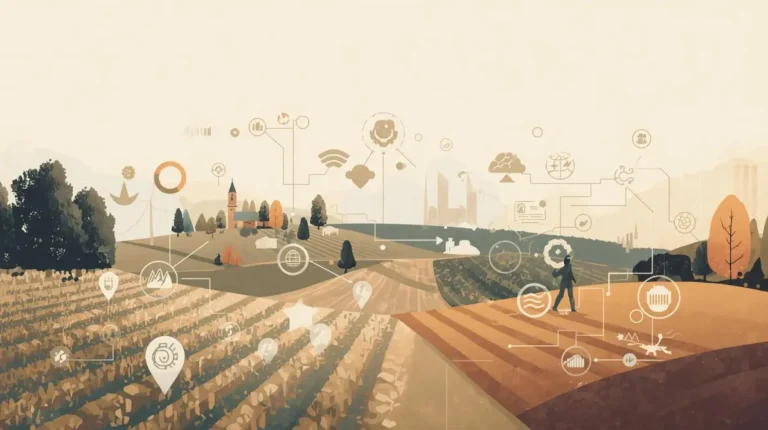
The practice combines data collection from field sensors, automated analysis, and equipment that adjusts inputs based on real-time measurements. Core components include soil moisture monitors, GPS-guided application equipment, crop health imaging, and platforms that aggregate this information into actionable timing or quantity changes.
A soil probe measures moisture at root depth. Software reads that measurement against crop water requirements. An irrigation valve opens or stays closed based on the calculation. The farmer checks results but doesn’t make the timing decision manually each day.
That’s the functional definition. Everything else is a variation on this pattern: measure conditions, compare to thresholds, trigger response.
The confusion starts when the term gets stretched to cover everything from a basic weather app to AI-driven autonomous tractors. Industry language often treats “smart farming,” “digital farming,” “precision agriculture,” and “Agriculture 4.0” as interchangeable. They overlap, but precision agriculture specifically focuses on variable-rate application of inputs based on field variability, while smart farming is broader and includes livestock monitoring, greenhouse automation, and farm management software.
What matters for decision-making is whether the technology collects data that changes what you do. A soil moisture sensor that triggers irrigation at a specific threshold qualifies. A dashboard that shows you data you already know and can’t act on differently doesn’t.
The distinction matters because marketing materials rarely specify which category a product falls into. Most technology gets labeled “smart” regardless of whether it automates a decision or just displays information.
Why the Term Gets Confusing in Practice
Smart farming became a marketing category before it became a stable set of practices. Every tech company with a product for farms now calls it smart farming.
This creates noise.
A 2023 European Commission report found that over 30% of farmers identified the complexity of understanding what these technologies actually do as a barrier to adoption. The problem isn’t that farmers can’t learn new systems. The problem is that the systems are sold with broad promises about efficiency and sustainability without specifying which tasks they affect and by how much.
Policy language compounds this. EU agricultural strategy includes digital transformation as a priority, with billions in funding allocated to support technology adoption. When policy documents, industry marketing, and actual on-farm utility all use the same vocabulary, separating what the technology does from what it’s supposed to achieve becomes difficult.
The term also absorbs whatever agricultural challenge is currently prominent.
Labor shortages dominate the discussion? Smart farming gets positioned as an automation solution. Environmental regulations tighten? Same technologies, repositioned as sustainability tools. Input prices spike? Suddenly, they’re about cost reduction.
This isn’t necessarily dishonest. Many technologies do address multiple concerns. But when one term becomes the answer to every question, it stops meaning anything specific.
Market growth numbers reflect investment and spending, not necessarily farm-level impact. The European smart agriculture market, growing from €6.3 billion to €19 billion by 2033, tells you where capital is moving. It doesn’t tell you which farms see reduced costs or which tasks actually get easier.
Smart Farming as a Tool for Reducing Operational Pressure
Where smart farming delivers measurable value, it usually does so by automating repetitive monitoring tasks or by providing data that changes input timing or quantity.
Automated irrigation systems that use soil moisture sensors reduce the need for manual field checks and can cut water use by 20-25% in regions where water application was previously based on schedule rather than need. This is a direct operational change: fewer hours spent on irrigation decisions, lower water costs, and in some cases, reduced crop stress from over- or under-watering.
Variable-rate fertilizer application based on yield maps or soil sampling reduces input costs by applying nutrients only where soil tests show deficiency. Farms using precision nitrogen management report input cost reductions of 10-15% without yield loss. This works when soil variability is high enough that uniform application was previously wasteful.
Livestock monitoring systems that track health indicators, feed intake, and reproductive cycles reduce the time spent on manual observation and can catch health issues earlier. A dairy farm using automated health monitoring might reduce veterinary costs by 8-12% and catch mastitis or lameness two to three days earlier than visual checks alone.
These examples share a pattern: they replace manual labor or guesswork with sensor-based data, and the data leads to a different action.
The value comes from what changes, not from having the data itself.
What doesn’t qualify as operational pressure reduction: dashboards that aggregate information you were already collecting manually, systems that require more data entry than they save in decision time, or monitoring tools that alert you to conditions you would have noticed anyway through normal field observation.
The gap between promised efficiency and actual time savings often comes down to whether the technology eliminates a task or just digitizes it. Digitizing without automation means you’re still doing the work, just on a screen instead of in a notebook.
Smart farming only addresses tasks where data collection and automated response are feasible. It doesn’t reduce the complexity of crop rotation planning, market risk, subsidy compliance, or labor coordination. It doesn’t solve structural problems like low commodity prices or dependency on subsidy payments.
It affects specific operational tasks. That’s the limit.
When a farm’s binding constraint is market access, regulatory burden, or shortage of skilled workers during harvest, smart farming tools aimed at crop monitoring won’t address the constraint. The technology might be useful in a general sense, but it doesn’t solve the problem that’s limiting your operation.
Structural Limits and Risks
The first limit is cost. Initial investment for smart farming systems ranges from €5,000 for basic sensor setups to €50,000 or more for integrated precision farming equipment. Large farms above 500 hectares represented 64% of smart farming deployments in Europe in 2024, not because small farms can’t use the technology, but because the cost per hectare becomes viable at scale.
Subscription-based models and machinery co-operatives are reducing the capital barrier for smaller operations, but the economics still favor farms with enough area to spread the fixed cost. A soil moisture monitoring system that costs €3,000 per year makes sense on 100 hectares of irrigated crops.
On 20 hectares, the per-hectare cost is prohibitive unless water is severely limited or expensive.
The second limit is skills and training. Research from the CODECS project, which engaged 148 participants across 18 European Living Labs, found that a lack of understanding was the primary barrier preventing farmers from investing in new agricultural technologies, ahead of financial constraints. Many farmers are not familiar with data management platforms, and there’s a learning curve to interpreting sensor outputs and translating them into field-level decisions.
Training programs exist, but they require time investment, and the value only materializes if the technology actually changes what you do. If you spend ten hours learning a farm management platform and then realize it doesn’t help with your specific bottlenecks, that’s time lost.
The third limit is connectivity. Smart farming systems rely on internet access for data transmission and cloud-based analytics. Rural areas in parts of Poland, Romania, and the Baltics still have gaps in fiber and mobile coverage.
Real-time data is only useful if it arrives in time to affect the decision. A soil moisture alert that arrives six hours late doesn’t help.
Regulatory complexity adds friction. Use of drones and autonomous machinery is tightly regulated in France and Germany, with airspace restrictions and data collection rules that vary by region. Compliance adds an administrative burden, which is the opposite of what smart farming is supposed to reduce.
Integration risk is real. Many smart farming systems don’t communicate well with each other. A farm might have a yield monitoring system from one vendor, a soil sensor network from another, and a farm management platform from a third. If those systems can’t share data automatically, the farmer ends up manually transferring information between platforms, which negates the efficiency gain.
Finally, there’s the mismatch between technology development and farm decision cycles. Tech companies develop products based on what’s technically possible and what scales across many farms. Individual farms make decisions based on immediate operational needs and cash flow constraints.
When those priorities don’t align, the technology sits unused or gets adopted for compliance reasons rather than operational benefit.
This creates a specific pattern: farms adopt technology to maintain subsidy eligibility or comply with environmental reporting requirements, but the technology doesn’t integrate into actual operational decisions. The system runs parallel to farm management instead of being part of it.
That’s cost without operational value.
The Decision on the Table
Most farms don’t need to decide whether smart farming is good technology. They need to decide whether it fixes something that’s currently costing them time, money, or control.
If you’re spending hours each week manually checking irrigation needs across fields with variable soil types, automated soil moisture monitoring might cut that time by 60-80% and reduce water costs by 20%. That’s a clear decision: calculate the cost per year, estimate the time saved, and input reduction, and decide if the return is above your threshold.
If your bottleneck is labor availability during harvest or market access for your product, smart farming tools aimed at crop monitoring won’t address the constraint. The technology might be useful in a general sense, but it doesn’t solve the problem that’s limiting your operation.
This is why adoption patterns are uneven across farms of similar size and type. The technology fits some operational structures and not others. A 200-hectare grain operation with high soil variability and access to variable-rate equipment sees measurable value from precision agriculture. A 40-hectare diversified vegetable farm with multiple crop types and intensive manual labor doesn’t, because the technology isn’t designed for that kind of complexity.
The practical approach: identify the specific task or input where you think smart farming might help, find out what the technology actually does in that context, calculate the cost, including setup and learning time, and estimate the operational change. If the numbers work, test it on a limited scale before full adoption. If they don’t, the decision is to wait until either the technology improves or your farm structure changes enough to make it viable.
Smart farming is a tool, not a strategy. It affects how you execute certain tasks, not whether those tasks are the right ones for your farm structure.
The decision comes down to three calculations: Does this technology eliminate a task or change an input decision you’re making now? Does the time or cost saving exceed the technology cost over 24 months? Do you have the connectivity, training access, and operational structure to integrate it without adding more complexity than it removes?
If all three are yes, it’s worth testing. If any one is no, the technology doesn’t fit your operation yet.